Seat Belt Trader Automotive Restraint Supply
About the business

A specialist in one component that has to be right.

Seat Belt Trader deals in automotive seat belts and restraint components. Not a general parts catalogue with belts in it — a business built around one product family, its vocabulary, its failure modes and the questions that decide which part actually fits.

Automotive safety components reach the people who need them through a chain, and each link solves a different problem. A manufacturer produces to a specification and a volume. A distributor holds and moves stock. Somewhere between that supply chain and the workshop floor sits a much less glamorous question: which one of these does this particular vehicle need?

That question is where a trading business earns its place. A seat belt is not a universal article. Anchorage spacing, webbing length, retractor mounting, tongue plate profile, buckle throat geometry, bolt specification and the route the belt takes through a guide or height adjuster all vary — and they vary between variants of the same model, and sometimes within a single production year. A part that is physically close but not correct will either refuse to mount, foul on trim, sit at the wrong angle across the occupant, or latch unreliably.

So our work is less about holding a catalogue and more about narrowing a requirement. Which vehicle, which seat, what is wrong with the existing assembly, how it is mounted, what the workshop can see when the trim is off. Once those are settled, sourcing the right product is comparatively straightforward. Skip them and no amount of stock solves the problem.

Why we stayed narrow

Breadth is easy to advertise and hard to deliver. A business selling everything from wiper blades to brake pads cannot reasonably hold detailed knowledge of retractor locking behaviour or why a tongue plate that inserts smoothly can still be the wrong part. We chose to stay inside one product family so that the conversation with a customer can be technical rather than transactional.

In practice that means we would rather ask three more questions than send something back and forth twice. It also means we will tell you when a requirement sits outside what we handle, or when the sensible answer is to have a workshop inspect the vehicle before anything is ordered at all.

Who we work with

Enquiries reach us from vehicle owners replacing a single belt, independent workshops sourcing on behalf of a customer, and operators maintaining a number of vehicles of the same type. The technical questions are the same in all three cases; what changes is the volume and how much of the vehicle detail the person on the other end already has to hand.

“Which belt fits?” is a question about the vehicle, not about the belt.

Every enquiry we handle begins the same way — with the make, model, model year, variant and seating position, and with what the existing assembly is actually doing wrong. It is a slower opening than quoting a price, and it is the reason the part that arrives is the one that fits.

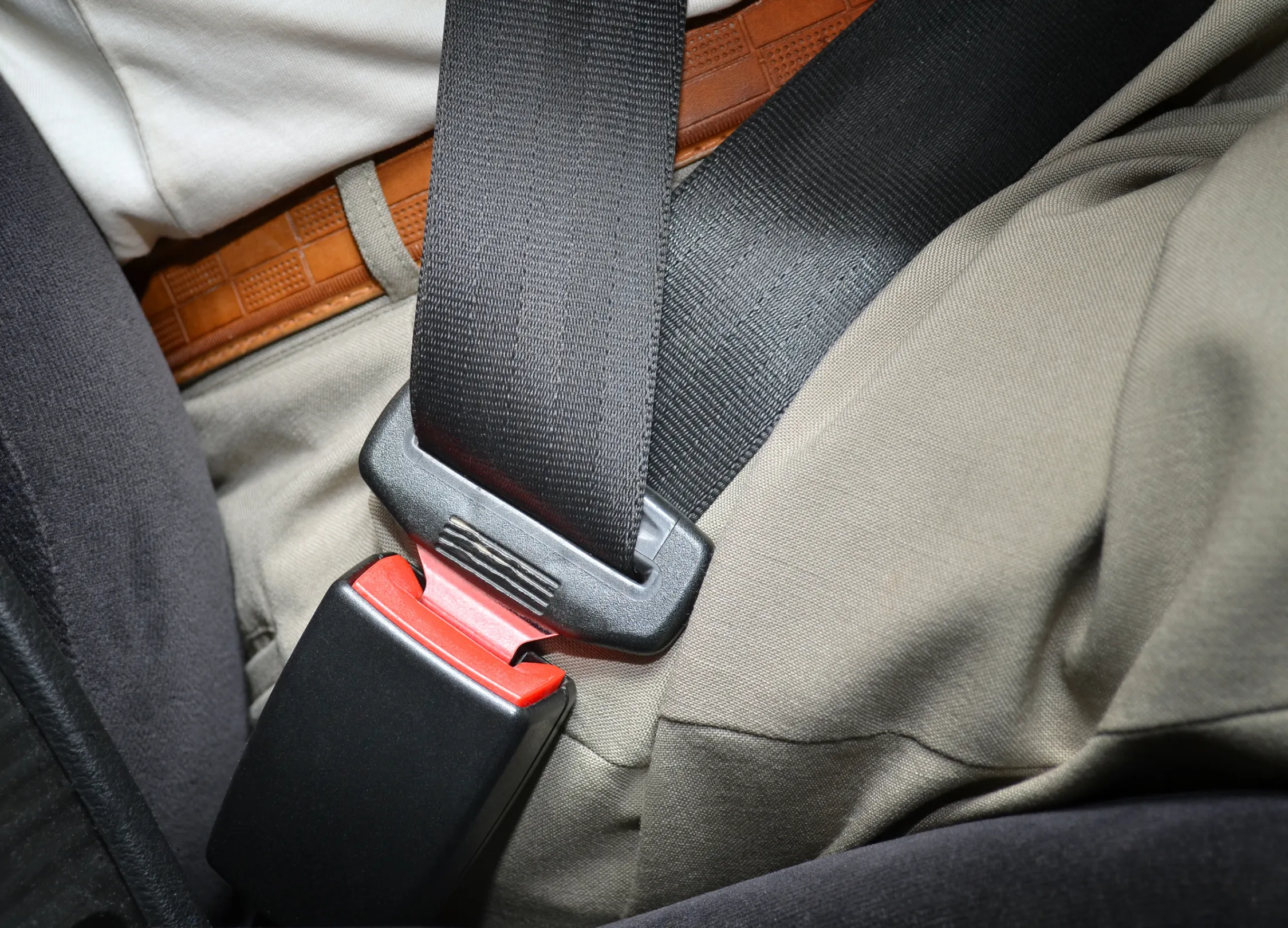
A driver seated in a car fastening a three-point seat belt, drawing the webbing down towards the buckle beside the seat.
Fig. 01 The routine that has to work every time, in every vehicle, without thought.
The product

A component that only matters at the moment it is needed

Most of a seat belt's working life is uneventful. It pays out, it retracts, it latches, it releases. The occupant barely registers it. That ordinariness is exactly what makes a degraded belt so easy to live with — a retractor that has become slow, a buckle that needs a second push, webbing that has gone stiff and glazed at the edge. None of it interrupts the journey.

The problem is that the restraint is judged on a single event it may never be asked to perform. There is no partial credit. Which is why the sensible position on a belt that is behaving oddly is to have it inspected by a qualified workshop rather than to wait and see whether it settles down.

  • Webbing that is cut, frayed, glazed, chemically stained or heat-damaged.
  • A retractor that will not take up slack, pays out in jerks, or does not lock when tugged sharply.
  • A buckle that needs repeated attempts to latch, or releases without deliberate pressure.
  • Any assembly that was loaded during a previous collision, whatever it looks like now.
Shared language

The vocabulary we will use with you

Enquiries move faster when both sides name the same parts the same way. These are the terms that come up in almost every conversation about a replacement.

Webbing
The woven strap itself. Its width, length and condition are all part of the specification, and its edges are usually where wear shows first.
Retractor
The spool mechanism that stores webbing, pays it out, takes up slack and locks under sudden extraction or deceleration.
Tongue plate
The metal latch plate that slides along the webbing and inserts into the buckle. Its profile has to suit the buckle it is entering.
Buckle / stalk
The receptacle that accepts and holds the tongue plate, usually on a short stalk or cable anchored to the seat frame or floor.
Anchorage point
Where the assembly is bolted to the vehicle structure or seat frame. Position, spacing and bolt specification are all fitment-critical.
D-ring / upper guide
The loop near the pillar that turns the shoulder belt down across the torso, sometimes with a height adjuster attached to it.
Three-point belt
The common arrangement with a lap section and a diagonal shoulder section sharing one continuous length of webbing.
Two-point / lap belt
A belt restraining across the pelvis only, still found in certain seating positions and vehicle types.
Working with us

How an enquiry actually runs

There is no portal and no automated quotation engine. It is a short, specific conversation, and this is its usual shape.

You send the vehicle details

Make, model, model year, variant and the seating position the belt is for — plus what is wrong with the existing part.

We ask what is still missing

Usually the mounting arrangement, whether the retractor is body- or seat-mounted, and a photograph of the installation.

We confirm what suits the application

Including whether the sensible answer is a complete assembly rather than an individual component.

You decide with the detail in front of you

No pressure to commit before the fitment question is settled to your satisfaction.

Fitment stays with a qualified workshop

We supply the part. Installation to the manufacturer's procedure and torque figures belongs with a competent technician.

The specification is on record for next time

Useful for operators running several vehicles of the same type who will need the same part again.

A fastened seat belt routed across an occupant's lap and hip, with the tongue plate engaged in the buckle beside the seat cushion.
Fig. 02 The lap section should sit low across the pelvis, not across the soft abdomen.
Straight answers

What we do not claim

Plenty of websites in this category assert certifications, decades of history, national coverage and client numbers that are difficult to verify. We would rather be useful than impressive, so here is the boundary.

  • We do not publish certifications, approvals or test results we cannot evidence.
  • We do not claim manufacturing capability. We are a trading and supply business.
  • We do not carry testimonials or client logos that have not been given to us to use.
  • We do not guarantee that any part is legally compliant for a given jurisdiction or use — that determination rests with you and the fitting workshop.
  • We do not offer fitting, inspection or certification services. Those belong with a qualified workshop.
Please note

Nothing on this website is technical, legal or safety advice for a specific vehicle. Decisions about whether a restraint should be replaced, and whether a given part is suitable and correctly installed, should be made with a qualified automotive technician who can examine the vehicle.

Get in touch

Have a vehicle and a part that needs replacing?

Send the make, model, year, variant and seating position, along with a photograph of the existing assembly. That is usually enough for us to tell you what suits the application.