01 · Passenger cars
Hatchbacks, sedans and SUVs
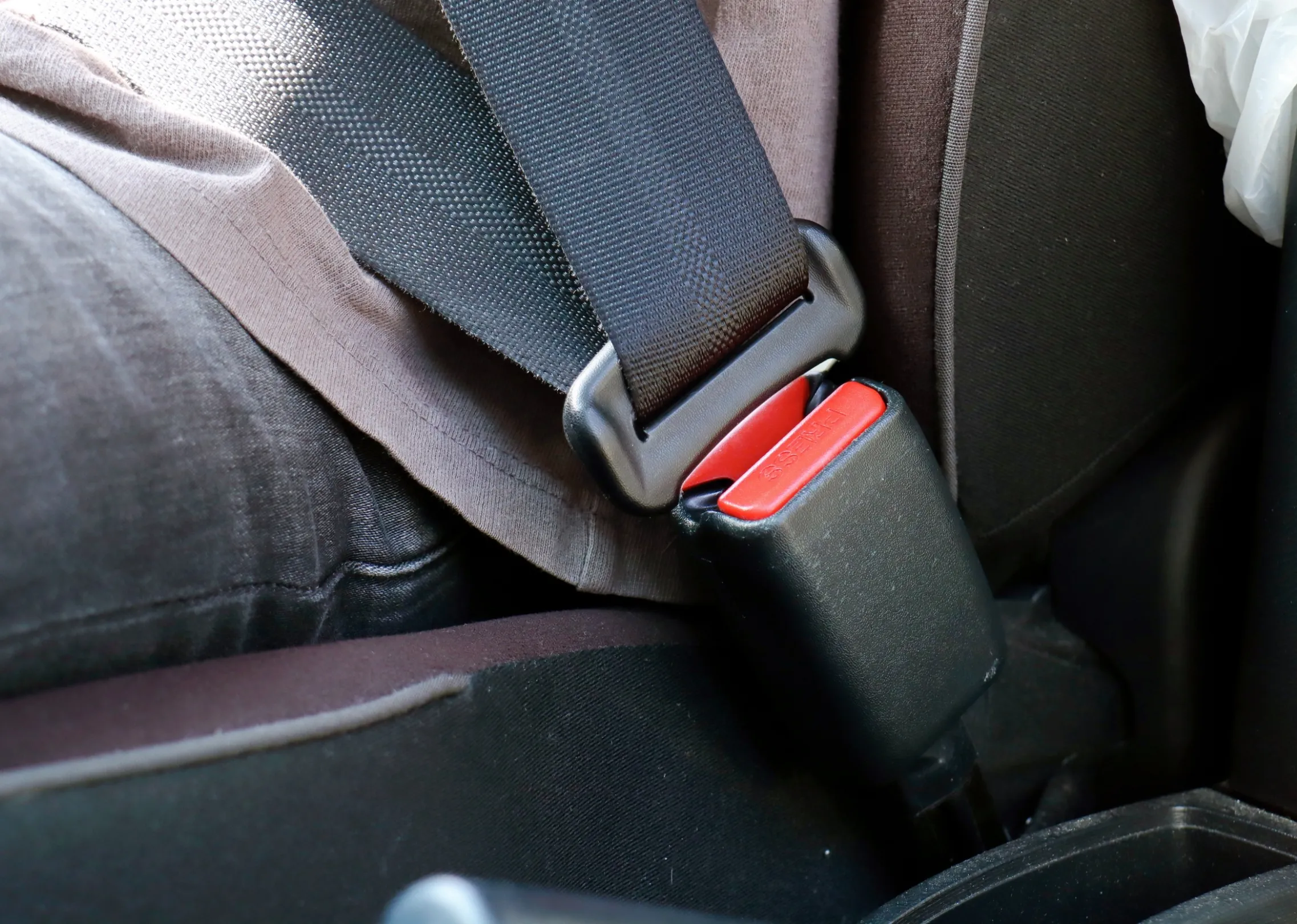
The most common enquiry we handle. Three-point belts with retractors at the front and
rear outboard positions, and increasingly at rear centre as well. The complication is
not the technology — it is that specification varies between variants of the same
model and, sometimes, across a single production year.
Rear seat belts are also the ones most often neglected. They are used less, so a
retractor that has become sluggish or a buckle that has collected debris can go
unnoticed for a long time. When a rear belt is finally needed, it needs to work.
Front rowRear outboardRear centreThird row
02 · Commercial & goods vehicles
Trucks, tempos and light commercial cabins
Commercial cabins are working environments. Belts are fastened and released far more
often, frequently by different drivers across shifts, and they are exposed to dust,
grit, moisture, workwear abrasion and sustained heat. All of that shortens practical
service life relative to a private car doing the same annual distance.
Contamination inside the buckle is a particularly common cause of unreliable latching
in working vehicles — a belt that needs two or three attempts to engage is reporting a
problem, not a habit.
LCVHCVTipperHaulageMulti-driver
03 · Buses & passenger transport
Coach, school and staff transport seating
Passenger transport introduces a different problem: repetition. Restraints are fitted
across many identical seating positions, and the practical requirement is consistency
of specification across the whole vehicle rather than identification of one part.
Seat construction here often differs from passenger cars — belts may anchor to the
seat frame rather than the vehicle body, and both two-point and three-point
arrangements appear depending on the seat design and the vehicle.
Coach seatingSchool transportStaff transport
04 · Fleet operations
Many vehicles, one specification
For operators running a number of vehicles of the same type, restraint checks tend to
sit inside scheduled maintenance rather than arising as one-off failures. The useful
thing we can offer is not speed on a single part but a settled specification that can
be reordered without repeating the identification exercise every time.
Once we have established what a given vehicle type takes, subsequent requirements
become a matter of quantity and timing.
Repeat supplyScheduled maintenanceStandardised spec
05 · Utility & special-purpose
Site transport and purpose-built bodies
Where a vehicle has been bodied or fitted out for a specific job, the seating
arrangement may not correspond to any standard passenger layout. Anchorage points may
have been provided by the body builder, seat positions may be unusual, and the belt
has to suit the installation that actually exists rather than a catalogue assumption.
These are the enquiries where photographs of the mounting points matter most, and
where we are most likely to ask for them before saying anything definite.
Site transportCustom bodiesNon-standard layouts
06 · Replacement & maintenance
Workshops and individual owners
The single largest category by volume. A belt that is cut or frayed, a retractor that
no longer retracts or locks, a buckle that has become unreliable, or an assembly that
was loaded during a collision and should be renewed rather than reused.
Whether the enquiry comes from a workshop sourcing on a customer's behalf or from the
vehicle owner directly, the information needed is the same — and fitting remains work
for a qualified technician following the vehicle manufacturer's procedure.
Independent workshopsOwner replacementPost-incident renewal