Seat Belt Trader Automotive Restraint Supply
Product range

Seat belts, component by component.

A restraint system is a small number of parts that have to agree with each other. This page sets out what each one does, what varies between vehicles, and what we need to know before we can tell you which version suits your application.

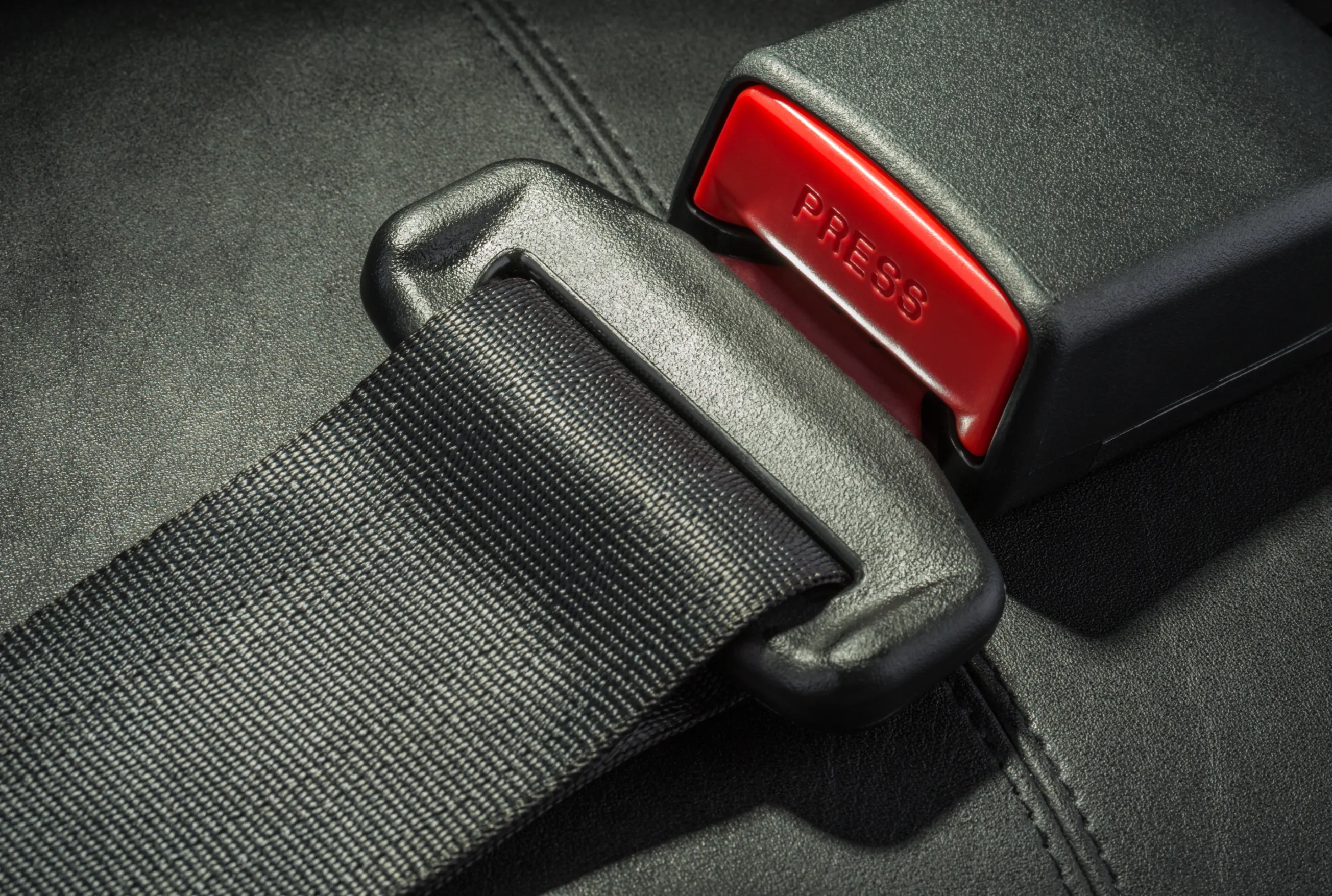
Macro photograph of a seat belt tongue plate fully latched into a black buckle receptacle with a red PRESS release button, on dark leather upholstery.
Fig. 01 Latched. The tongue is held by the buckle's internal catch until the release is pressed deliberately.
The range

What we supply

The categories below describe the shape of what we trade in. Availability of any specific part depends on the vehicle, the configuration and current sourcing — so please treat this as a map of the territory and send us the actual requirement.

01

Seat Belt Assemblies

A complete assembly is supplied as a working unit — webbing, retractor, tongue plate and, depending on the design, the buckle stalk. Because the parts have been matched to each other, an assembly removes the most common source of error in restraint supply: components sourced separately that are individually plausible but do not work together.

Where a belt has failed in service, replacing the assembly rather than a single component is usually the more dependable route. A retractor that has stopped locking cleanly, for instance, may have been stressed by the same event that damaged the webbing.

Typically includes
Webbing, retractor unit, tongue plate, mounting hardware
Varies by
Vehicle, seating position, anchorage layout, belt length
Tell us
Make, model, year, variant, seat position, mounting type
02

Three-Point Seat Belts

The familiar arrangement in modern passenger vehicles: one continuous length of webbing forming a lap section across the pelvis and a diagonal shoulder section across the chest, with three anchorage points. The geometry is what makes it effective — restraint load is shared between the pelvis and the rib cage rather than concentrated in one place.

Fitment differences between vehicles are frequently invisible until installation is attempted. Anchorage spacing, the height and position of the upper guide, webbing length and whether a height adjuster is present all change the specification, and they can differ between the driver's side and the passenger's side of the same car.

Common positions
Front row, rear outboard, and increasingly rear centre
Fitment-critical
Anchorage spacing, upper guide position, webbing length
Watch for
Left- and right-hand versions are not interchangeable
03

Two-Point & Lap Belts

A two-point belt restrains across the pelvis only, using two anchorage points. It is still found in specific seating positions and vehicle types — certain rear centre seats, some commercial and utility layouts, bench seating, and passenger transport applications where the seat structure or vehicle design does not carry an upper anchorage.

Where a lap belt is the correct arrangement for a position, fitting one is a matter of matching anchorage spacing, webbing length and the adjuster or retractor type. Where a three-point belt is the original specification, a lap belt is not a substitute for it.

Common positions
Rear centre, bench seating, certain commercial layouts
Configurations
Static adjustable, or retractor-equipped
Tell us
Anchorage spacing and how the belt is currently secured
04

Retractor Units

The retractor is the mechanism that makes a modern belt usable. It stores the webbing on a spool, pays it out as the occupant reaches and moves, draws the slack back in, and locks the webbing when it detects rapid extraction or sudden vehicle deceleration. Without it a belt would have to be manually adjusted every time, and slack would be left in the system.

Retractors differ in mounting — some bolt to the body structure behind trim, others are integrated into the seat frame — and in locking behaviour. Some are standard emergency locking units; others can be switched into a mode that locks the webbing at a fixed length for securing certain loads or seats. These are not interchangeable choices, and the correct type depends on the vehicle and the seating position.

Function
Pay-out, retraction, slack take-up, emergency locking
Mounting
Body-mounted behind trim, or integrated into the seat frame
Symptoms of failure
No retraction, jerky pay-out, permanent lock, no lock on sharp tug
05

Buckles, Stalks & Tongue Plates

The latching interface is a pair, not two independent parts. The tongue plate profile — its thickness, the shape of its shoulder, the position and size of its aperture — has to suit the throat and internal catch of the buckle it enters. Tongues that insert smoothly into the wrong buckle, and buckles that accept a tongue but do not hold it securely, are both failure modes worth taking seriously.

Buckle stalks vary in length, in whether they are rigid or cable-mounted, and in how they anchor to the seat frame or floor. On some vehicles the buckle also carries a switch for the belt reminder system, which makes electrical connector type part of the specification.

Pairing matters
Tongue profile must suit the buckle throat and catch
Stalk varies by
Length, rigid or cable, anchorage and orientation
Check for
Belt reminder switch and its connector, where fitted
06

Webbing & Mounting Hardware

Belt webbing is a woven strap engineered to a specific width, construction and controlled extension characteristic. It is not general-purpose strapping, and its condition is one of the clearest indicators of whether an assembly should stay in service — cuts, fraying along an edge, glazing, stiffness, chemical staining and heat damage all matter.

Around the webbing sits the hardware that routes and secures it: upper guides and D-rings, height adjusters, anchor plates, bolts and spacers. Bolt thread specification and the presence of the correct spacers and washers are part of a safe installation, which is one reason restraint work belongs with a qualified workshop.

Hardware
Guides, D-rings, height adjusters, anchor plates, fixings
Condition markers
Cuts, fraying, glazing, stiffness, staining, heat damage
Installation
Correct bolt specification and torque, by a qualified workshop
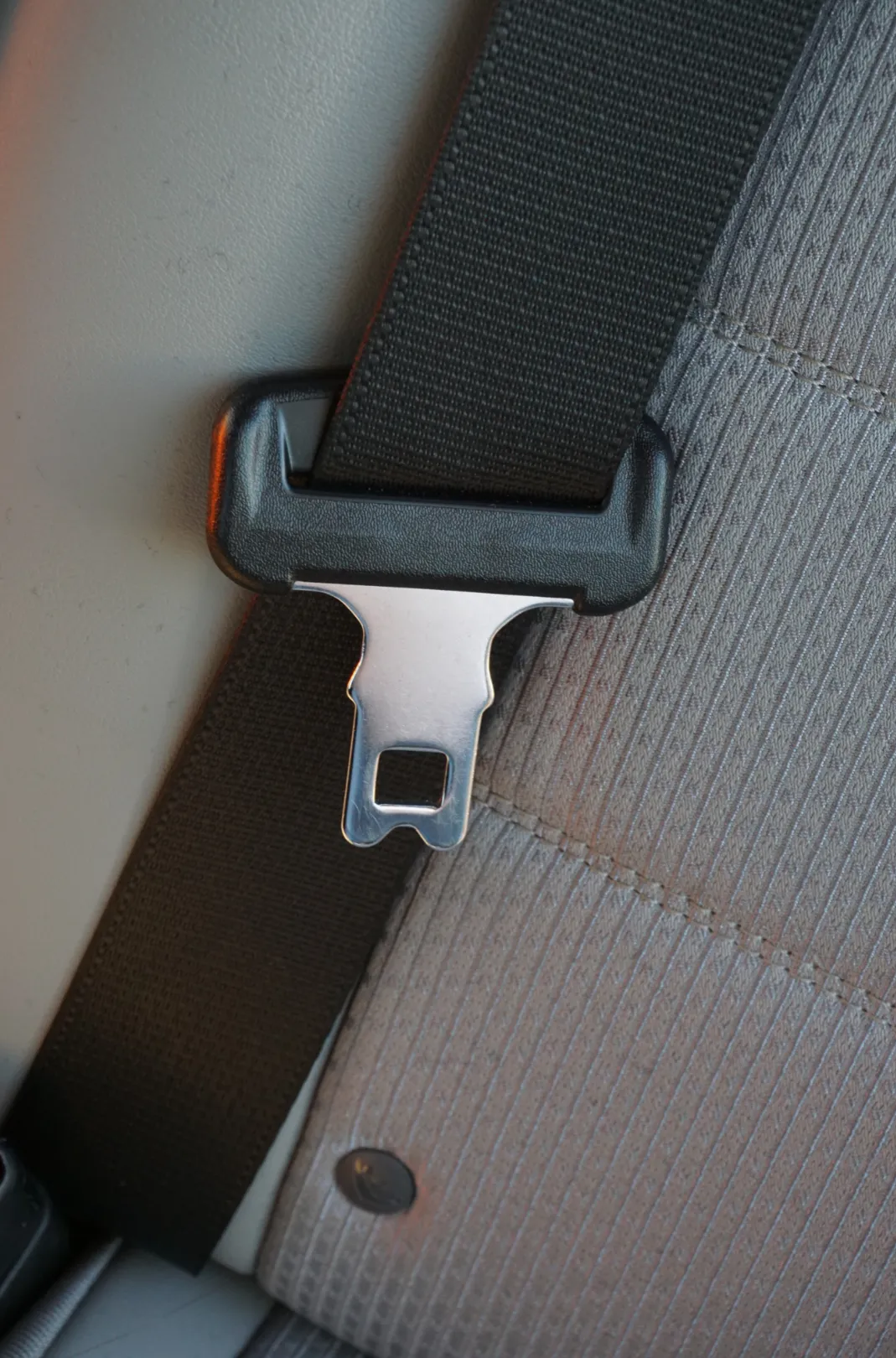
A polished steel seat belt tongue plate resting in a moulded webbing guide on a grey fabric vehicle seat.
Fig. 02 The tongue plate slides freely along the webbing and parks in its guide when unfastened.
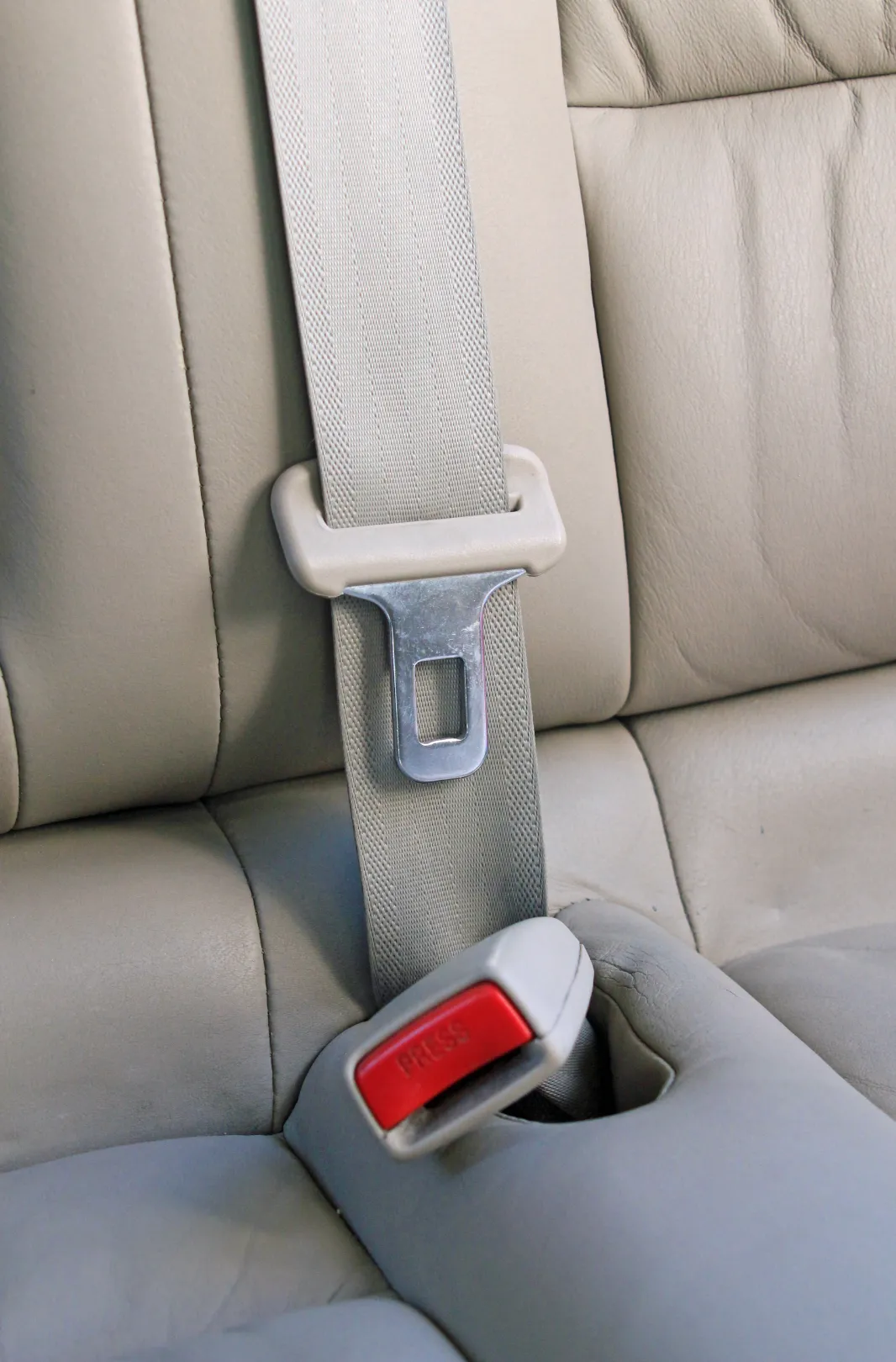
A three-point seat belt on a light-coloured leather rear seat, showing the shoulder webbing, tongue plate and buckle with a red PRESS release.
Fig. 03 A rear-seat three-point installation — belt length and anchorage differ from the front row.
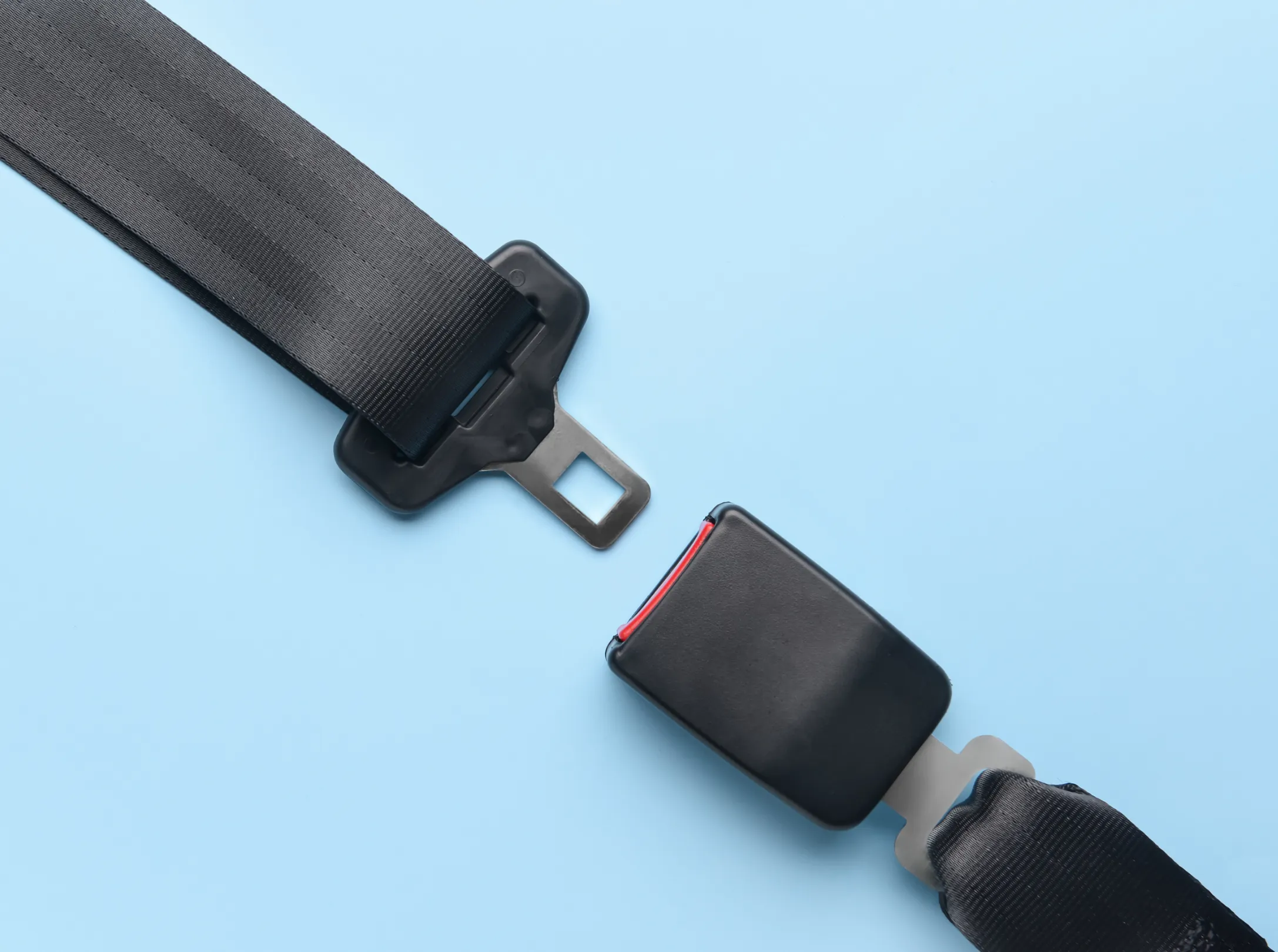
A seat belt tongue plate and buckle laid out separately on a plain pale background, showing the webbing, latch plate and release button.
Fig. 04 Tongue and buckle as separate items — the pairing has to be confirmed, not assumed.
07 · Replacement

Replacement Seat Belts

Most of what we supply is a replacement for something that has stopped doing its job properly. The reasons are consistent: webbing damage, a retractor that no longer retracts or locks, a buckle that has become unreliable, or an assembly that was loaded in a previous collision and should not be returned to service regardless of how it looks.

Two points are worth stating plainly. First, a restraint that has been through a collision should be assessed by a qualified workshop, not judged by appearance. Second, correct parts installed incorrectly do not restrain correctly — anchorage bolts, spacers and torque figures are part of the safety function, not assembly details.

Before you order

Have the make, model, model year, variant and seating position ready, along with a photograph of the existing installation including the mounting points. Any legible part number on the belt or its label helps, though it is often absent or worn away.

08 · Commercial

Commercial vehicle applications

The physics does not change between a hatchback and a haulage cabin, but almost everything around it does. Commercial restraint requirements tend to differ in four ways.

01
Duty cycle
A commercial cabin belt may be fastened and released many more times per day than a private car's, and across multiple drivers. Mechanical wear on the buckle and retractor accumulates faster, and practical service life is shorter.
02
Operating environment
Dust, grit, moisture, workwear abrasion and sustained cabin heat all act on webbing and on the mechanism. Contamination inside a buckle is a common cause of unreliable latching in working vehicles.
03
Seat construction
Suspension seats, fixed bench arrangements and purpose-built bodies change where the belt anchors and how long it needs to be. A belt suited to a fixed seat may not suit a seat that travels vertically on its suspension.
04
Fleet consistency
Where several vehicles of the same type are maintained together, the practical need is repeat supply of one known-correct specification rather than a fresh identification exercise on every occasion.
Next step

Tell us the vehicle and we will narrow the part.

Make, model, year, variant, seating position and a photograph of the existing installation are usually enough to get to a definite answer without guesswork.