Frequently asked questions
Answers to what we are actually asked — about compatibility, configurations, retractors and buckles, when a belt needs looking at, and what to send us so an enquiry can be settled in one exchange rather than four.
Start with the vehicle — make, model, model year and variant — and the exact seating position the belt is for. Then establish the mounting arrangement: where the assembly fixes to the body or seat frame, and whether the retractor is body-mounted or built into the seat.
Finally, be specific about what is wrong with the existing part. Frayed webbing, a seized retractor and an unreliable buckle can point to different replacements, and "the seat belt is broken" does not distinguish between them.
Compatibility is decided by physical fit and function together: anchorage points and spacing, bolt and thread specification, webbing length, retractor mounting and locking behaviour, and whether the tongue plate profile suits the buckle in the vehicle.
Two belts can look nearly identical and still differ on one of these, and none of those differences are obvious in a photograph of the part on its own. The reliable approach is to supply the vehicle details along with photographs of the existing installation, including the mounting points.
A three-point belt uses one continuous length of webbing to form a lap section across the pelvis and a diagonal shoulder section across the chest, anchored at three points. A two-point or lap belt restrains across the pelvis only, using two anchorage points.
Three-point belts are standard in modern passenger vehicles. Lap belts are still found in certain rear centre positions, bench seating and some commercial and transport layouts. Where the original design specified a three-point belt, a lap belt is not an equivalent substitute for it.
Yes, and the differences are frequently invisible until installation is attempted. Anchorage spacing, upper guide position, webbing length, retractor mounting, tongue plate profile and bolt specification all vary between vehicles.
They also vary between variants of the same model, between the left and right sides of the same car, and across a single production year as manufacturers make running changes. This is why model year and variant matter as much as the model name.
Generally not. Front and rear positions differ in webbing length, anchorage geometry and often retractor type. On many vehicles rear outboard and rear centre are entirely different parts as well, and left and right versions are not interchangeable with each other.
A belt described as being for a particular model is not necessarily for a particular seat in it.
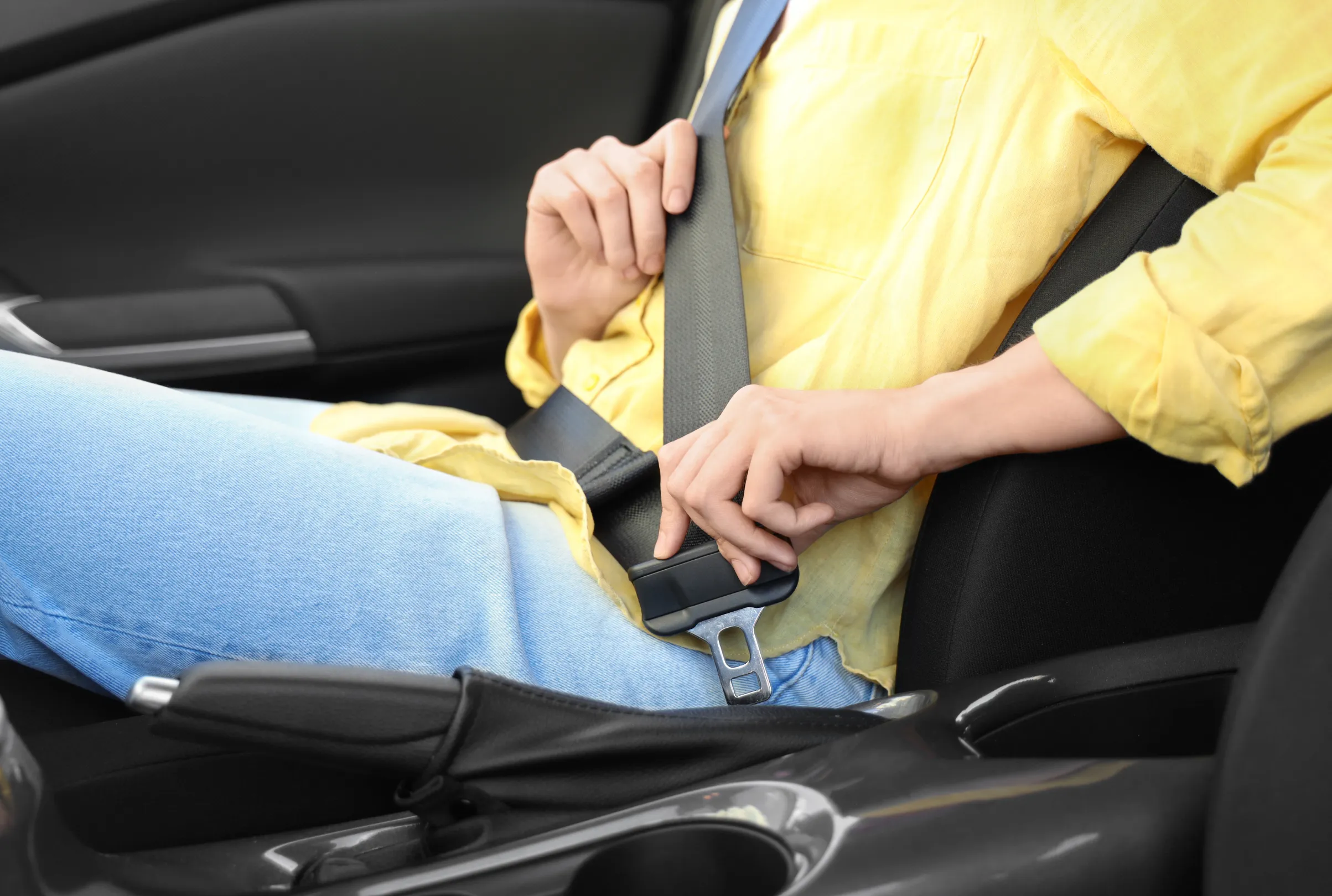
The retractor is the spool mechanism that stores the webbing, pays it out as the occupant moves, takes up slack so the belt sits against the body, and locks the webbing when it senses rapid extraction or sudden vehicle deceleration.
It is what allows a belt to be comfortable in normal use while still restraining under load. Without it, a belt would need manual adjustment at every use and would inevitably be left with slack in the system.
That is the retractor working as designed. Emergency locking retractors respond to rapid webbing extraction by locking the spool. Pulling the belt out slowly and steadily normally allows it to pay out freely.
The situations worth acting on are the opposite ones: a belt that locks during slow, ordinary movement and will not release without slackening, or a belt that does not lock when tugged sharply. Both should be inspected by a qualified workshop.
It needs inspecting first. Poor retraction can come from a retractor fault, from webbing that has become twisted or contaminated, or from the belt catching on trim or a seat mechanism. A qualified workshop can determine which, and whether the assembly should be replaced.
It is not a symptom to live with. A belt that will not take up slack is not holding the occupant the way it was designed to.
Yes. A correct latch has a distinct character: the tongue enters without force, seats with an audible and tactile click, and cannot be withdrawn by pulling on the webbing. Release should require deliberate pressure and should then be immediate.
Repeated attempts usually indicate contamination in the buckle throat or wear in the mechanism. It should be assessed by a workshop rather than treated with lubricants or solvents, which can attract further debris or affect the mechanism.
Anchorage points are engineered to carry restraint load into the structure of the vehicle. Bolt specification, spacers, washers and torque figures are part of that engineering, not assembly details.
Routing the webbing correctly through guides and height adjusters also determines how the belt sits on the occupant. Correct parts fitted incorrectly do not restrain correctly, which is why installation should be carried out by a qualified workshop following the vehicle manufacturer's procedure.
Have a belt inspected if the webbing is cut, frayed, glazed, stiffened, chemically stained or heat-damaged; if the retractor will not retract, pays out in jerks, stays locked or fails to lock on a sharp tug; if the buckle needs repeated attempts to latch, releases without deliberate pressure or has a sticky release; if webbing is twisted and will not lie flat; or if there is visible damage, corrosion or looseness at an anchorage.
A restraint that was worn during a collision should always be assessed, regardless of how it looks afterwards.
A restraint that was worn during a collision should be assessed by a qualified technician following the vehicle manufacturer's guidance. Belts can absorb energy in ways that are not visible — webbing extension, stress within the retractor mechanism, deformation at an anchorage.
Whether the assembly can remain in service is a professional determination, not something to judge by appearance.
Restraint webbing and hardware should not be modified, shortened, knotted, sewn or otherwise altered. Whether any part of an assembly can be serviced rather than replaced is a determination for a qualified workshop following the vehicle manufacturer's guidance.
In most cases where a belt has failed in service, replacing the complete assembly is the more dependable route, because the parts arrive already matched to each other.
There is no single universal interval that applies to every vehicle. Some manufacturers issue their own guidance, and practical service life varies considerably with use and environment.
A multi-driver commercial cabin exposed to dust, heat and constant buckling will age its restraints faster than a private car covering the same distance. Condition and function are the practical guide, checked by someone qualified to assess them.
Vehicle make, model, model year and variant; the seating position; the quantity required; and a specific description of the fault or reason for replacement.
Then the details that most often get missed: whether the retractor is body-mounted or built into the seat, whether a height adjuster or upper guide sits in the belt's path, and whether the buckle carries a wiring connector for a belt reminder system.
Photographs of the existing assembly showing the retractor, the buckle and the mounting points are the single most useful thing you can send. Any legible part number helps too, though it is often absent or worn away.
Yes. Commercial cabins, goods vehicles, buses and passenger transport, utility vehicles and fleet operations are all applications we handle.
For operators running several vehicles of the same type, once a specification has been established it can be reordered without repeating the identification exercise each time.
No. Seat Belt Trader is a trading and supply business. We do not manufacture seat belts or restraint components, and we do not present ourselves as doing so. What we bring is product knowledge and the discipline of matching a specific requirement to the correct part.
No. We supply parts. Installation should be carried out by a qualified workshop working to the vehicle manufacturer's procedure, including correct bolt specification, spacers and torque figures. Anchorage integrity is part of the safety function of the restraint system, and it is not work to improvise.
If your question is not here, send it. Questions about routing, fitment or what to check before ordering are part of what we do — and if something falls outside what we can properly advise on, we will tell you that rather than guess.
Your question is probably about your vehicle.
General answers only go so far. Send the make, model, year, variant and seating position and we can be specific instead.